The Case for Nomadic Furniture in Times of Crisis
Why It Matters Now More Than Ever
Furniture is, by nature, a localized object. It costs money to move weight across long distances, and the math rarely works out in the furniture's favor. A sofa that cost $800 might cost $400 to move across the country when you factor in space, weight, and gas. That's why so many people freely give away large pieces or sell them for pennies on the dollar at the end of a lease, just to avoid the trouble. Part of what you pay for when you buy furniture is the delivery and the placement — operating under the assumption that you'll stay put long enough to make it worthwhile.
Furniture's relationship to place goes beyond logistics. Historically, different materials evolved in response to local climates. Dense hardwoods thrived in temperate forests. Woven reeds and lightweight bamboo suited humid coastal regions. A fine piece of furniture built in the moisture-rich air of the American South can crack and split when moved to the Southwest, because the wood contracts in the dry desert air. The piece carries its origin in its grain.
Furniture is inherently not nomadic. It belongs to a place and is an expression of that area's geography, culture, and climate.
Nomadic Furniture Is a Contradictory Concept, But We Need It
There's a tension embedded in modern life that didn't exist for most of human history. On one hand, we carry a deep, almost biological need for rootedness: for a place that is ours, arranged the way we like, surrounded by the things that make daily life comfortable and convenient. We want to feel at home, even when home is temporary. But the conditions of modern life — mobile careers, short-term leases, and rising costs — make it increasingly difficult to justify permanence in our furniture choices.
Nomadic furniture is a design response to that tension. It expresses a contradictory desire: to have everything needed for a functional, comfortable life without being burdened or bound to one place by static, heavy, expensive objects.
In a world where jobs are precarious, housing markets are volatile, and the average person moves more than a dozen times in their lifetime, being able to pick up and go without financial penalty is a real survival skill. The freedom to move quickly is, for some people, the freedom to survive.
DIY as Crisis Design
People's interest in DIY tends to spike during economic downturns, and the reason is simple: when incomes fall and budgets tighten, people build what they can't afford to buy.
This has been true across generations. During the Great Depression, families repurposed shipping crates and salvaged lumber into functional household objects. During the stagflation of the 1970s, a counterculture DIY movement flourished, producing hand-built furniture, woodworking magazines, and entire ecosystems of self-sufficiency. The 2008 financial crisis brought another wave — Etsy launched in 2005, and maker culture exploded in the years that followed. The pattern is consistent: economic instability drives people toward the satisfaction and practicality of making things themselves.
DIY, in this sense, is a form of crisis design — born not from comfort and abundance but from constraint and necessity. And constraints, as any designer will tell you, often produce the most interesting solutions.
Where DIY Meets Nomadic
Here's where the two ideas converge: the skills required to build DIY furniture are precisely the skills that make furniture nomadic.
When you build a piece of furniture yourself, you understand its joinery, its fasteners, and its sequence of assembly. That means you can also take it apart. You know which bolts to remove, which panels separate first, how the whole thing breaks down into components that fit into a car or ship flat in a box. Your knowledge transforms the furniture from a static object into something closer to a utility — portable, repeatable, and adaptable.
Flat-pack ready-to-assemble (RTA) furniture took a step in this direction, making furniture easier to ship and assemble once. But it was never designed for multiple moves. The particleboard degrades. The cam locks strip out. The second assembly is worse than the first, and by the third move, it's essentially toxic firewood.
Real nomadic furniture is designed with the full lifecycle and many moves in mind. It's built from materials that hold up to repeated assembly and disassembly — not just the first build. It packs flat without losing structural integrity. And ideally it's modular, so the same components that form a bed frame in one apartment can become a desk or shelving system in the next. Nomadic furniture adapts to whatever space you're in, rather than forcing the space to adapt to it.
Nomadic Furniture for a Rootless Age
Nomadic furniture is a response to a moment in history when owning lots of things feels more like a liability than a sign of success. When the housing market is uncertain, when the next job might be in a different city, when the rising cost of living may force a move, nomadic furniture alleviates the pain of transition and makes starting over somewhere new a lot easier.
The goal for Gen Z and many Millennials isn't to accumulate possessions the way that previous generations did, leaving behind a trail of abandoned furniture at every doorstep and hauling around boxes of accumulated junk. The goal now is to move fluidly through life while retaining mobility, optionality, and simplicity.
What Nomadic Furniture Looks Like Today
The idea of nomadic furniture has existed for generations, but the execution is finally catching up.
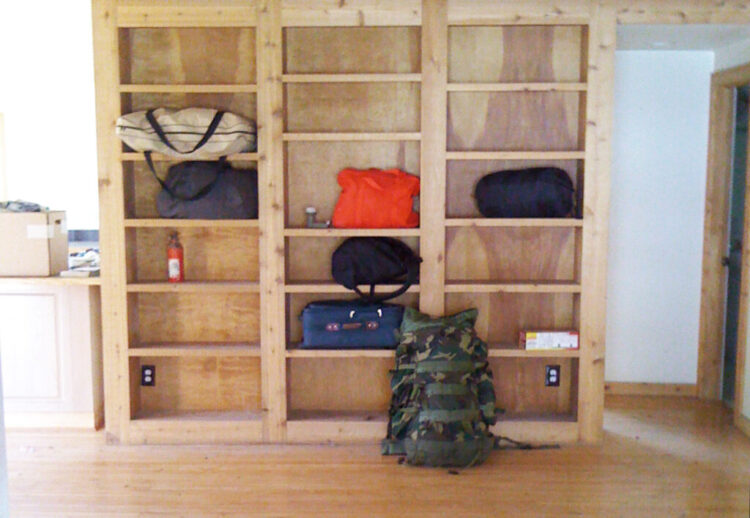
Muvo is a modular furniture system designed from the ground up for people who move frequently, or who simply don't want to be held hostage by their stuff. Muvo Boxes assemble into a bed frame, a desk, a shelving unit, a closet organizer, or a gear wall, depending on what your space calls for. No tools. No hardware. No particleboard.
When it's time to go, Muvo Box turns into moving boxes for your move. Then when you arrive somewhere new, you build what you need. The furniture holds up to repeated moves and heavy duty use.
If you're furnishing a space that you're not sure you'll stay in, or are tired of the cycle of buying cheap furniture and leaving it behind, see what Muvo Box can do.
✉️If this resonates, don't miss the next post.
Get Muvo delivered to your inbox.